
Healthcare in Pakistan is gradually moving from paper-based records and manual registers toward digital systems. For private clinics, one of the most important steps in this transformation is adopting an Electronic Medical Record (EMR) system.
A clinic EMR allows doctors and clinic staff to maintain patient information digitally, including medical history, diagnoses, prescriptions, laboratory reports, appointments, and other clinical information.
As clinics become busier and patient records become more difficult to manage manually, an EMR can help organize clinical information and make everyday clinic operations more structured.
What Is a Clinic EMR?
An Electronic Medical Record (EMR) is a digital version of a patient’s medical record maintained by a healthcare provider.
Instead of searching through paper files or previous prescriptions, the doctor can open a patient’s digital record and review relevant information from previous visits.
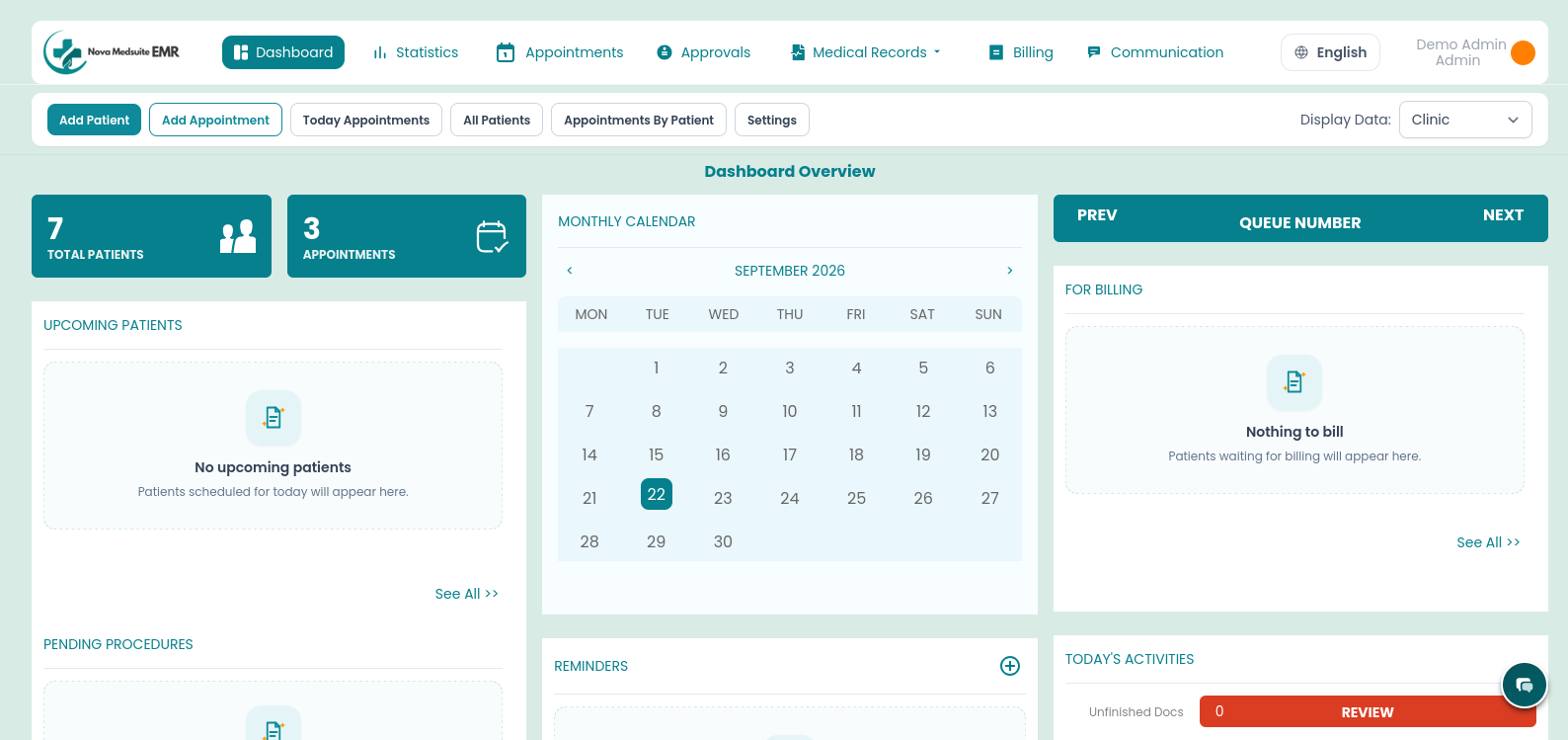
A clinic EMR may include:
- Patient registration and demographic information
- Previous medical history
- Doctor’s consultation notes
- Diagnoses
- Prescriptions
- Allergies and medications
- Laboratory reports
- Radiology reports and documents
- Appointment history
- Follow-up records
- Billing information
- Digital patient documents
The exact features depend on the software and the requirements of the clinic.
Why Are Pakistani Clinics Moving Toward EMR?
Many clinics still depend heavily on handwritten prescriptions, registers, paper files, and manually maintained financial records.
As patient volume increases, these methods can create practical problems.
A previous record may be difficult to locate. A prescription can become damaged or lost. A receptionist may need to search through registers to confirm an appointment. Clinic management may also have limited visibility into daily patient visits and revenue.
Digital records provide a structured alternative.
Pakistan is also seeing broader movement toward digital healthcare. In January 2026, the Government of Pakistan announced the operationalization of a paperless, telemedicine-enabled Basic Healthcare Unit at Gokina, Islamabad, including electronic medical records and digital prescriptions.
Government healthcare technology projects have also included EMR/HIMS implementations covering patient registration, billing, medical records, e-prescriptions, investigations, pharmacy and appointments.
What Should a Clinic EMR in Pakistan Include?
A useful EMR should not simply replace a paper file with a digital screen. It should support the actual workflow of a clinic.
1. Digital Patient Registration
Reception staff should be able to register a patient quickly and create a permanent digital record.
Basic information can include:
- Patient name
- Contact information
- Age and gender
- Address
- Medical record number
- Previous visit information
This eliminates the need to create a new paper file every time the patient visits.
2. Complete Patient History
One of the biggest benefits of an EMR is having the patient’s previous visits available in one place.
A doctor can review:
- Previous consultations
- Diagnoses
- Prescriptions
- Investigations
- Follow-ups
- Uploaded reports
- Previous procedures
This creates a longitudinal view of the patient’s treatment history.
Pakistan’s telemedicine policy has also identified the ability to collate all visits of a particular patient as an important EMR capability.
3. Digital Prescriptions
Instead of handwritten prescriptions, doctors can generate structured digital prescriptions.
Depending on the system, prescriptions can include:
- Medicine
- Dosage
- Frequency
- Duration
- Instructions
- Follow-up recommendations
The prescription can then be printed or delivered digitally to the patient.
4. Appointment Management
An EMR can be connected with appointment scheduling.
Clinic staff can manage:
- Today’s appointments
- Doctor schedules
- Follow-up appointments
- Patient queues
- Waiting patients
- Completed consultations
For multi-doctor clinics, centralized scheduling can become particularly useful.
5. Laboratory and Medical Reports
Patient reports can be stored with the relevant medical record.
Instead of keeping laboratory reports in separate physical files, clinic staff can attach digital documents to the patient’s profile.
The doctor can then review previous investigations during a consultation.
6. Billing and Financial Records
A modern clinic system can connect clinical activity with billing.
For example:
Patient registration → Consultation → Prescription → Billing → Payment record
This creates a digital trail for clinic transactions and can make daily financial reporting easier.
7. Role-Based Access
Not every employee needs access to every part of a patient’s record.
A clinic EMR can provide different access levels for:
- Doctor
- Receptionist
- Nurse
- Accountant
- Administrator
Role-based access helps clinics control what different staff members can view or modify.
8. Data Backup and Ownership
Medical records are valuable clinical information. Clinics should consider how their data is stored, backed up, exported, and recovered.
Before selecting an EMR, clinic owners should ask:
Who owns the data?
Can the clinic export its records?
How frequently are backups performed?
What happens if the clinic changes software providers?
These questions are particularly important when choosing a cloud-based healthcare platform.
Cloud EMR vs Paper Records
| Feature | Paper Records | Cloud EMR |
|---|---|---|
| Patient history | Manual files | Searchable digital history |
| Prescription | Handwritten | Digital |
| Appointment management | Register/phone | Digital schedule |
| Reports | Physical documents | Digital attachments |
| Backup | Physical copies | Automated backup options |
| Access | Physical file location | Authorized digital access |
| Reporting | Manual | Automated reports |
| Multi-doctor management | Difficult | Centralized |
A cloud EMR can be particularly useful for clinics that want authorized staff to access records from different devices, subject to the system’s security and access controls.
Is EMR Suitable for Small Clinics?
Yes. An EMR does not have to be designed only for large hospitals.
A small private clinic may initially need only:
Patient Registration + EMR + Prescription + Appointments + Billing
As the clinic grows, additional modules can be introduced.
For example:
Phase 1: Patient records and prescriptions
Phase 2: Appointments and billing
Phase 3: Pharmacy and laboratory
Phase 4: Patient portal and digital communication
Phase 5: Analytics and multi-branch management
This allows a clinic to adopt digital systems without implementing a large hospital information system from day one.
What Should Doctors Consider Before Choosing an EMR in Pakistan?
Before purchasing clinic software, doctors and clinic owners should look beyond the number of features.
Consider:
Ease of use
Doctors should be able to access patient history and create notes quickly. A complicated interface can make adoption difficult.
Data security
Ask how patient information is protected, who can access it, and whether access is logged.
Backup and recovery
Understand how frequently backups are performed and what happens if the system experiences an outage.
Data export
The clinic should understand whether its records can be exported in a usable format.
Scalability
The system should be able to support additional doctors, staff, branches, or modules as the clinic grows.
Local support
For Pakistani clinics, local support can be valuable when staff need onboarding, training, troubleshooting, or workflow customization.
The Future of Clinic EMR in Pakistan
The role of digital records is likely to extend beyond simply replacing paper files.
Future clinic systems can connect EMR with:
- Digital appointments
- Telemedicine
- Laboratory systems
- Pharmacy management
- Patient portals
- Mobile applications
- Analytics
- Automated reminders
- Clinical decision-support tools
Government technology requirements in Pakistan already demonstrate an interest in electronic health records, patient-facing portals, online/offline functionality, integration with clinical workflows, security testing, encryption, and Urdu/English interfaces in relevant digital-health projects.
The direction is therefore not simply paper → computer.
It is toward a connected digital workflow where patient information, clinical care and clinic operations can work together.
Conclusion
A Clinic EMR in Pakistan can help transform a clinic from a collection of paper files and manual registers into a structured digital practice.
The goal should not simply be to digitize paperwork. A good EMR should make it easier for doctors to understand patient history, for staff to manage appointments and records, and for clinic owners to maintain better operational visibility.
For Pakistani clinics considering digital transformation, the most important questions are not only “How many features does the software have?” but also:
Is it easy for my doctors to use?
Is my patient data secure?
Can I access complete patient history?
Can I maintain control of my data?
Can the system grow with my clinic?
Choosing an EMR around these practical requirements can make the transition to digital healthcare much more useful for both clinics and patients.



 Chat on WhatsApp